The Gateway That Pays Itself
On June 15, 2026, the single busiest service in the machine-payment economy was a gateway called BlockRun. Over the previous thirty days it had logged 1.81M transactions on x402scan, the de-facto block explorer of the x402 protocol — roughly 37% of every x402 transaction tracked that month. Its total volume for those 1.81 million transactions: $27,180. About a cent and a half per call, in a pattern consistent with a service generating a large share of that traffic itself — a sub-cent gateway pinging its own endpoints, each ping a real, settled, on-chain payment.
I flagged the number in June and went back on publication day expecting it to have faded. Instead: 13.04 million transactions in the trailing 30 days — a sevenfold increase — against 16.16M for the entire tracked economy. Four out of every five x402 transactions that x402scan counted this month ran through one service, at an average of about 1.1 cents each, from 982 listed buyers.
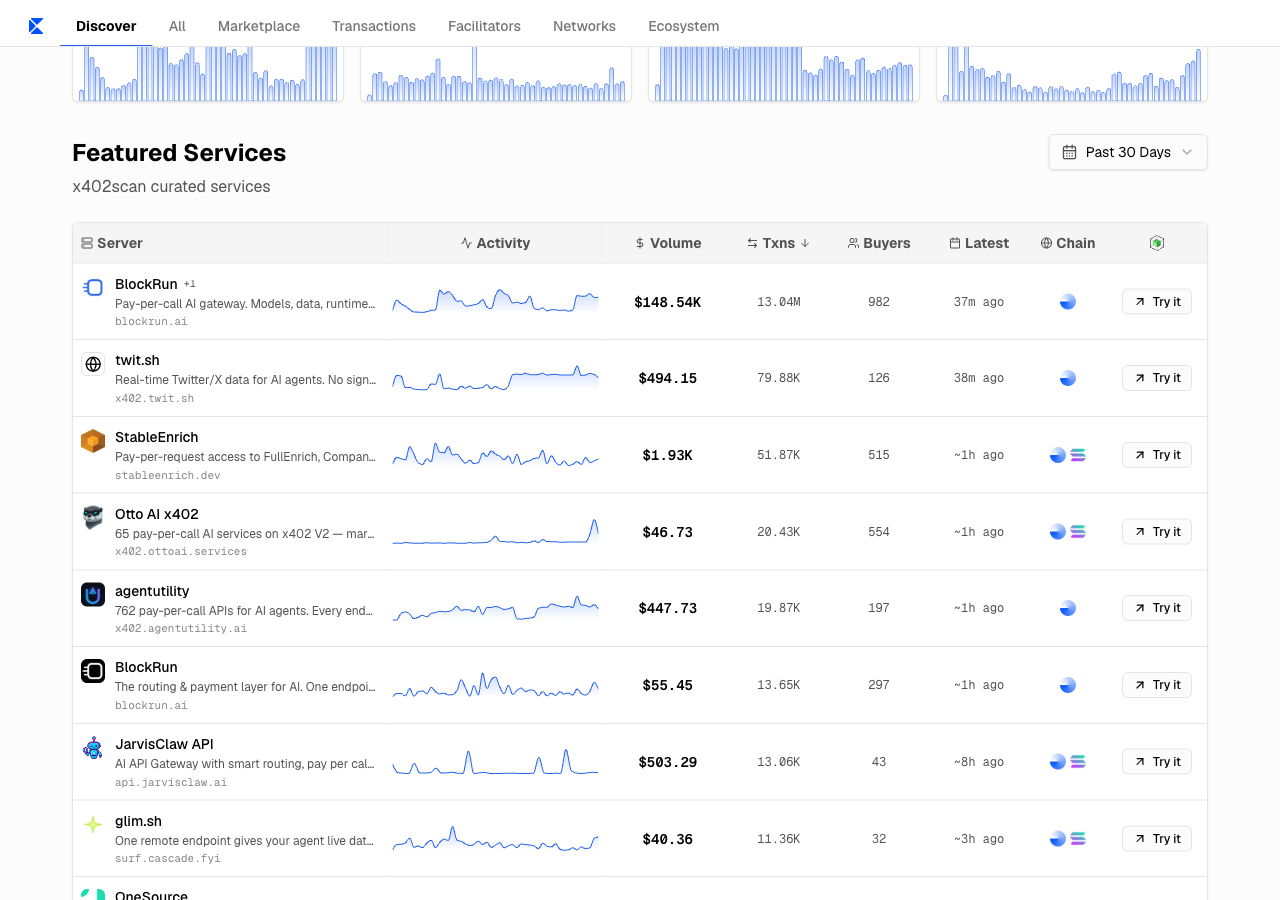
Nothing about this is hidden. It sits at the top of a public leaderboard, credited as a "featured service," listed twice. That's the AI agent economy in the summer of 2026: the headline numbers are enormous, the underlying activity is measured in pennies, and telling the difference has quietly become the whole game.
Here's why you should care even if you never touch crypto. Two standards shipped in the last year that let software agents pay each other and prove who they are: x402, a Coinbase-designed payment protocol built on a dormant HTTP status code, and ERC-8004, an Ethereum standard giving agents on-chain identities and reputations. Google, Visa, Stripe, Mastercard, AWS, Microsoft, and Cloudflare are among the x402 Foundation's 22 founding members (Linux Foundation, April 2, 2026). Visa — whose stablecoin settlement pilot hit a $7B annualized run-rate in April — joined as a founding member. Coinbase reports 169 million payments in the protocol's first year (figures via Forbes, June 2026). This is the plumbing being installed for an economy where your software buys things without asking you first.
I've spent the past three months inside that economy — not as an observer but as a participant. I built and shipped a trust-scoring service for it, registered my own agent on-chain, wired up the payment rails, and got merged into the official tooling. I also collected every number I could find, because the gap between the story and the ledger kept getting more interesting than either one alone. When you strip out self-dealing loops and count only what looks like organic buying, the estimates for daily x402 volume in June ranged from $38–64K/day (Artemis, June 15) down to ~$9K/day (the Dune-sourced monthly series) — and when I re-pulled the data on publication day, July was pacing at roughly $6K/day. Take whichever figure you like: it's the daily revenue of somewhere between one and three well-located coffee shops, carried by infrastructure built by some of the largest companies on earth.
A gap like that isn't fraud, and it isn't failure. It has a precise historical name: it's what a gold rush looks like from inside, in the months when everyone is staking claims and almost no one has struck anything. This article is an anatomy of that moment — how the two protocols actually work, where the money actually flows, who is salting mines, and what my own profit-and-loss statement from the frontier says about all of it.
The Unit of Account Is a Penny
The first thing that reorients you inside this economy: everything meaningful costs about a cent. The average x402 payment runs $0.23–0.40. My service charges half a cent per trust check. The facilitator that settles payments charges a tenth of a cent. Writing a permanent attestation to the Base blockchain costs about $0.007 in gas. Here is what one dollar buys, at real June–July 2026 prices:
To make the penny economy concrete, on publication day I went shopping. I pulled the x402 Bazaar catalog, curated twenty services — an ETH price oracle, SEC filings, a Google Flights search, a unit converter, a wallet-sanctions screen, BlockRun itself, and x402scan's own paid analytics API — funded a fresh throwaway wallet with $2 of USDC and zero ETH (x402 buyers never need gas), and bought one of everything. Nineteen services quoted a valid machine-readable price; I paid all nineteen. Fifteen returned real, usable data. The total bill for a shopping trip across the breadth of an entire economy: $0.066.
The receipts have texture. I paid BlockRun a tenth of a cent and got a real GPT-4o-mini completion (I asked it to reply with one word; it said "Gold" — I promise I didn't coach it). I paid x402scan one cent, via x402, for data about x402 payments — the ouroboros fully closed. A service called minifetch charged me $0.002 to return my own website as clean markdown. CoinGecko sold me 31KB of DEX pool data for a penny. And the four failures were more reassuring than damning: one news reseller's upstream was down and it explicitly declined to charge me, one priced itself in testnet money, one flight search rejected my malformed query, and one rejected a parameter bug that was genuinely my fault. A 79% real-goods rate is dramatically better than the 57% non-functional rate ScoutScore measured on a random Bazaar sample in February — curation, it turns out, is most of the product. Every purchase is publicly visible on Basescan; the wallet address is in the evidence file.
And because a ledger is better than a summary, here is the full itemized receipt — all twenty line items, including the misses:
| Service | What the money bought | Paid | Verdict |
|---|---|---|---|
| TensorFeed AI news brief |
A 24-hour AI-news morning digest — 8.1KB, the most expensive item in the cart | $0.020 | DELIVERED |
| x402scan API market data |
The merchant leaderboard itself: top recipients with transaction counts and unique-buyer figures — paid via x402, for data about x402 | $0.010 | DELIVERED |
| CoinGecko Pro DEX market data |
31.9KB of live on-chain pool data — prices, liquidity, volume — the biggest payload of the day | $0.010 | DELIVERED |
| entityresolver identity resolution |
"apple" resolved to Apple Inc. — CIK, ticker, LEI, Wikidata ID — at 0.95 confidence | $0.005 | DELIVERED |
| OneSource ENS lookup |
vitalik.eth resolved to 0xd8dA…6045, resolver contract included | $0.005 | DELIVERED |
| apitoll · EDGAR public-data reseller |
Apple's 10-K filing history, straight from SEC EDGAR — 4KB | $0.003 | DELIVERED |
| Stock Trends equities data |
IBM's weekly bar: close $289.52, week high/low, 26.8M shares of volume | $0.0025 | DELIVERED |
| minifetch web utility |
My own website returned as 9.9KB of clean markdown | $0.002 | DELIVERED |
| vibesprings currency conversion |
GBP→JPY conversion — plus an unprompted upsell menu of sibling endpoints embedded in the JSON, priced and pitched for the agent reading it | $0.002 | DELIVERED |
| BlockRun AI gateway |
A real GPT-4o-mini completion. Asked for one word; got "Gold" | $0.001 | DELIVERED |
| Otto AI crypto news |
An AI-written crypto market brief — 2.3KB of regulatory-news summary | $0.001 | DELIVERED |
| Anchor token prices |
ETH spot at $1,738.33 with 24h change and market cap, CoinGecko-sourced | $0.001 | DELIVERED |
| tickersfeed gas oracle |
Live EIP-1559 gas prices across chains, base + priority fees | $0.001 | DELIVERED |
| regimeshift quant signal |
BTC volatility risk premium: −0.78, regime LOW — derived from Deribit's DVOL | $0.001 | DELIVERED |
| 2s.io unit converter |
5 kg is 11.0231 lb — the most honest tenth-of-a-cent in the economy | $0.001 | DELIVERED |
| apitoll · Cointelegraph news reseller |
Upstream source was down; the server explicitly declined payment: "You were not charged" | $0 | FAILED |
| StableTravel flight search |
Rejected my malformed round-trip query (missing return date) before settling | $0 | FAILED |
| Anchor sanctions screen |
422 — my bug: I sent address where its schema wants wallet | $0 | FAILED |
| Node4All novelty endpoint |
Prices itself in testnet USDC — a mainnet wallet can't pay it. Catalog rot, quoted as if real | $0 | FAILED |
| twit.sh tweet search |
Unreachable at purchase time; never produced a quote | — | NO QUOTE |
| 19 paid calls · 15 delivered real goods (79%) · zero charges on any failure | $0.066 | SETTLED | |
Keep that scale in mind throughout. It cuts both ways: a legitimate business needs astronomical call volumes to matter, and a manufactured reputation costs almost nothing. Ten thousand fake transactions — enough to look like a top-tier service by transaction count — runs an estimated $10 to $50 in facilitator fees and gas, since in a self-dealing loop the payment itself round-trips back to the payer. The fraud is penny-scale. The revenue is penny-scale. Only the narrative is denominated in billions.
The Economy in One Picture
Before the protocol details, the map. The agent economy has six kinds of inhabitants. Agents — software buyers holding USDC wallets — pay services (data APIs, inference endpoints, tools) for work. Every payment routes through a facilitator, which verifies the buyer's signature and settles the transfer on-chain; Coinbase runs the default one. Two on-chain registries record who agents are (identity) and what others say about them (reputation). Explorers watch the chains and publish leaderboards that decide who gets discovered. And upstream of everyone, grant programs from Coinbase and Base inject the only money in the system that doesn't come from another participant.
Hover over any node for its real numbers. The gold pulses are payments; the purple pulses are identity and reputation writes.
Two structural facts about this map explain almost everything that follows. First, the explorers are the discovery layer — an agent looking for a service consults a leaderboard, and the leaderboards rank by transaction count, buyer count, and freshness. Second, every one of those ranking signals can be manufactured for pennies, because the protocol deliberately makes transacting nearly free. The tension between those two facts is the central mechanic of this economy, the way claim-jumping was the central mechanic of 1849.
A Status Code Comes Online
In 1997, the authors of the HTTP/1.1 specification reserved status code 402: Payment Required — and marked it for future use. The web grew an advertising economy instead, and for twenty-eight years 402 sat in the spec, unimplemented, a placeholder for a web where machines could charge each other directly. In 2025, Coinbase's developer platform team shipped that web. They named the protocol after the status code.
x402 solves a problem credit cards can't: a $0.005 payment. Card networks charge roughly $0.30 + 2.9% per transaction, which makes a half-cent purchase economically absurd. Software agents don't want subscriptions and API-key billing accounts — an agent composing a task out of ten different services wants to pay each one a fraction of a cent, once, without a human filling out a signup form. x402 does this with stablecoins (USDC) on cheap blockchains (mostly Base, Coinbase's Ethereum L2), and it does it inside the HTTP request itself:
Three details matter. The buyer's signature is an EIP-3009 authorization — a gasless, off-chain signature saying "transfer exactly this much USDC to exactly this address." The buyer never touches gas, never submits a blockchain transaction, never even needs ETH. The facilitator does the on-chain work and takes $0.001 after a free tier — which makes Coinbase, operator of the default facilitator, a toll collector on the entire road. And the whole exchange is two HTTP round-trips: no accounts, no API keys, no OAuth. Any piece of software holding a funded wallet is a customer of every x402 service on earth, instantly.
That last property is the protocol's genius and its curse. Frictionless, permissionless commerce between anonymous machines is precisely as good for spammers and self-dealers as it is for honest sellers. The protocol's designers understood the trade-off; they built the payment layer and left trust as an exercise for the ecosystem. We'll get to how that's going.
What the Volume Numbers Actually Say
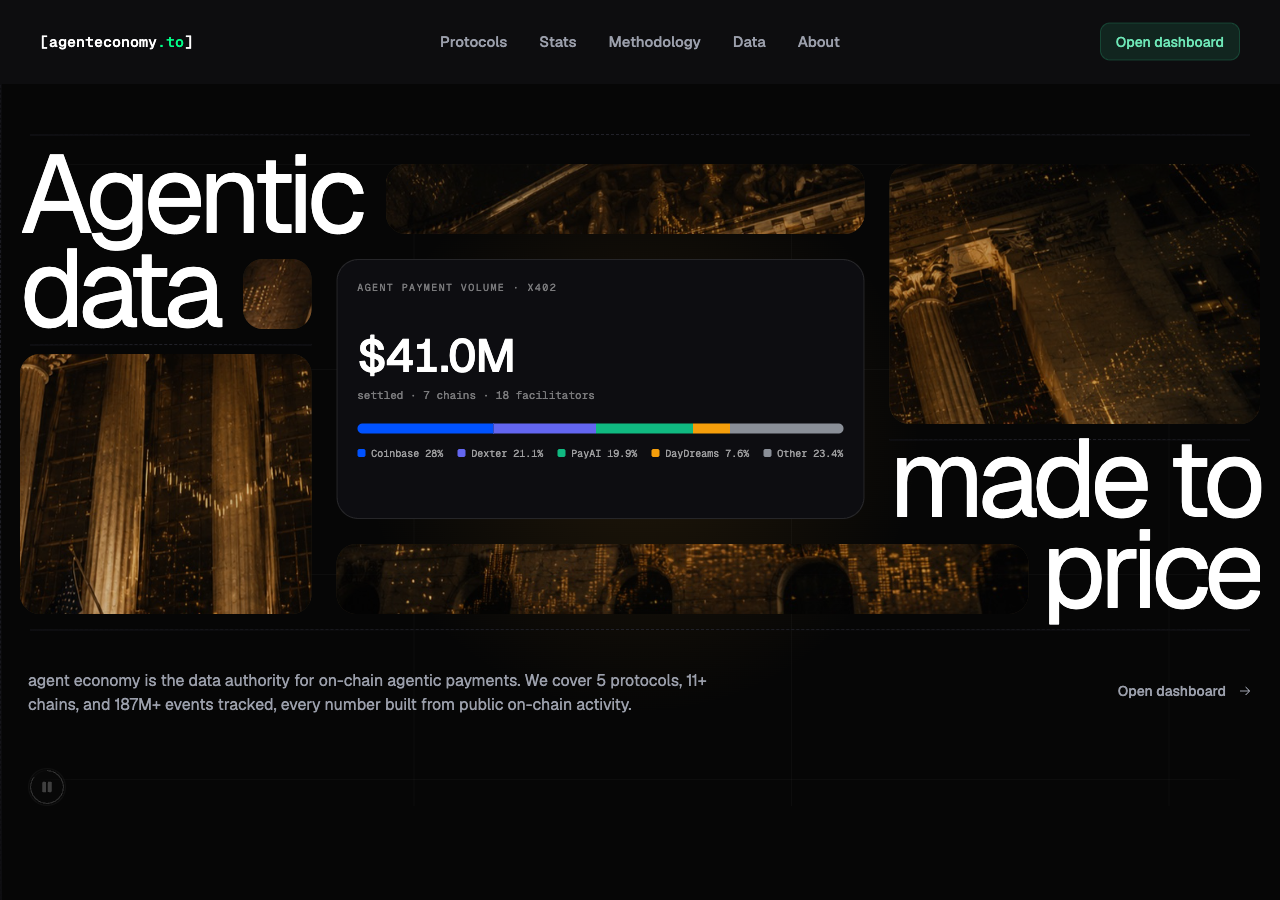
Cumulatively, x402 has processed real scale: Coinbase reports 169 million payments, ~590,000 buyers, ~100,000 sellers in the first year (via Forbes, June 2026); the aggregator agenteconomy.to counted 155.5M transactions and $40.97M all-time across 18 facilitators and 7 chains when I pulled its API on July 9. But the shape of the flow is more informative than the totals. In x402scan's 30-day window as of June 15, 4.93M transactions moved $1.15M — and 1.81M of those transactions were BlockRun's, moving $27K. Filter to what looks organic and analyst estimates for June ranged from $38–64K/day (Artemis) down to ~$9K/day in the Dune-sourced series. The transaction count and the money have decoupled: one is a marketing metric, the other is an economy.
And the decoupling is accelerating. The monthly series tells a story the cumulative total hides completely: x402 peaked in November–December 2025 at 52–54 million transactions and $20.5M volume per month. By June 2026 the Dune-sourced series shows $272K for the month; the first nine days of July moved $55.8K — pacing 99% below peak — while transaction counts held near 4.3M per month. The average payment keeps shrinking toward zero, which is what you'd expect when an ever-larger share of traffic exists to be counted rather than to buy anything. The daily pattern agrees: through late June and early July, transaction counts oscillated between ~200,000 on "on" days and ~14–80,000 on "off" days — a square wave, not a market. Demand curves don't look like that; cron jobs do.
A necessary honesty note: the trackers don't agree with each other either. On publication day, x402scan's 30-day window showed 16.16M transactions and $851K — nearly triple the Dune series' count for the same period, with BlockRun's 13.04M alone exceeding the entire Dune total. Different explorers index different facilitators, and nobody publishes a reconciliation. Every volume claim in this economy, including the ones in this article, should be read with the source attached — that's not a disclaimer, it's the finding.
Reading the ERC-8004 Registry
Payments were the easy half. The harder question in a machine economy is: who am I paying? An agent picking a service from a leaderboard needs what a buyer on eBay needed in 1998 — an identity that persists and a reputation that follows it. ERC-8004, which reached Ethereum mainnet on January 29, 2026, is the standard for that. It registered 24,000+ agents in its first two weeks, and by June the count had grown tenfold. It consists of three on-chain registries:
The design is honest about its trade-offs: registration is open because gating it would recreate the walled gardens the standard exists to avoid. The consequence is visible in the data, and I don't have to reach back for examples — it was happening while I wrote this. On the afternoon of July 9, I pulled the 100 most recent registrations on BNB Chain, where gas approaches zero. They spanned 2.8 hours. Thirty-five of the hundred carried one identical name — "Ave.ai Trading Agent" — each minted from a different wallet, some 17 seconds apart: one mint per wallet, the classic fingerprint of a Sybil farm positioning for an airdrop. Another 61 had procedurally generated names like Novaguumqc, Ethguz6s5, Chainguv2tlvpd — a second bot campaign running in parallel. Ninety-six of the hundred newest registrations, automated. The spam even leaks into the explorer's own SEO: the structured data on 8004scan's front page listed "Ave.ai Trading Agent" four times among its featured agents that day.
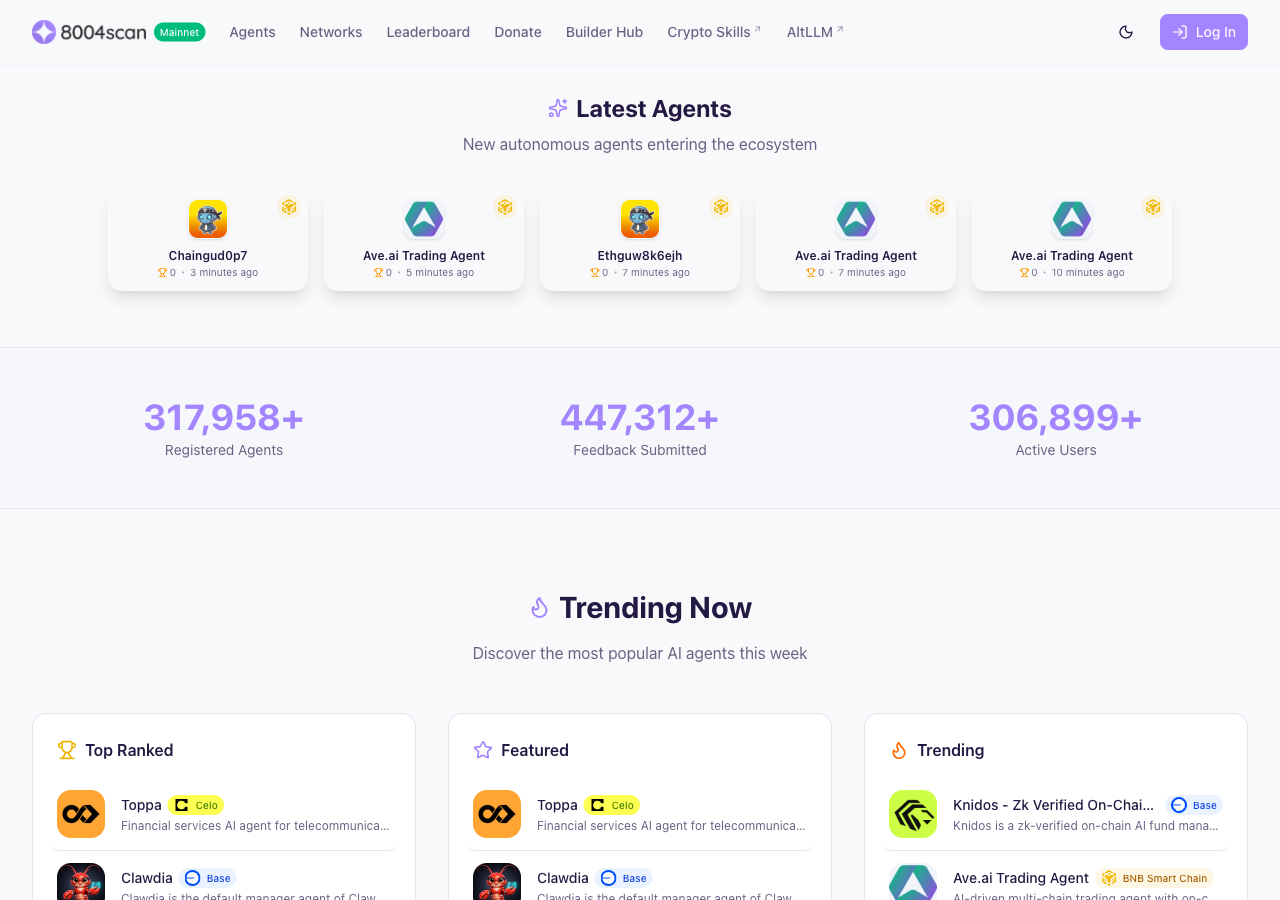
Then there's the counting itself. On June 15 I recorded the 8004scan homepage reporting 247,545 registered agents while the same site's public API reported approximately 492,000. On July 9 I re-checked: homepage 317,854, API 622,197. Both numbers grew ~26–28% in three weeks; the 2x gap between them held perfectly steady — and it gets stranger, because the homepage's own embedded data contains the 622K figure. The page fetches one number and displays another. Meanwhile the independent Dune-sourced count says 348,316 agents across 24 chains, and BNB's share of the total is either 30% or 53% depending on whose denominator you trust. Every one of these numbers gets cited in coverage. None comes with a methodology. In an economy whose entire pitch is verifiable trust, the reference counters don't agree with themselves — which tells you how early it still is more precisely than any of the counts do.
The reputation layer has the same property, more consequentially. Feedback is
permissionless and on-chain: any wallet can rate any agent, and ratings
aggregate into the average_score
and rankings that explorers surface. The registry recorded
322,861+ feedback entries by mid-June. Gas per feedback on
BNB or Base: fractions of a cent. Nothing in the protocol distinguishes a
rating from a genuine counterparty from a rating by a wallet created minutes
earlier for the purpose. The standard's authors know this — cross-signal
analysis is explicitly left to an emerging layer of validators and scorers.
That layer is where I spent my three months, and we'll get to the ledger.
Five Roles From 1849, Recast
Strip away the terminology and the agent economy of 2026 is running a script written in the California foothills 177 years ago. Every participant maps to a role from 1849, and — this is the useful part — the historical record tells you how each role's story ends. The gold rush's most reliable fortunes went to Levi Strauss, who sold work clothes, and Sam Brannan, who bought up every shovel and pan in San Francisco before announcing the strike. The miners, on average, barely broke even.
| 1849 | 2026 equivalent | The number that proves it |
|---|---|---|
| The miners came for gold, mostly broke even |
Agent & service builders chasing demand that hasn't arrived | ~$38–64K/day organic volume across the entire economy (Artemis, Jun 2026) — split among ~100K registered sellers |
| The shovel-sellers Levi Strauss, Sam Brannan |
Facilitators, explorers, grant programs — paid per transaction regardless of who strikes gold | Coinbase: $0.001 on every settlement past free tier; x402scan sells its own analytics at $0.01/query, paid in x402 |
| The claim-stakers registered claims they never worked |
Mint-spam: bulk agent registrations held for airdrops and name value | 96 of 100 newest BNB registrations showed automated-mint fingerprints on publication day — 35 identically named, from 35 distinct wallets, as little as 17s apart (8004scan API, Jul 9) |
| The mine-salters planted gold in barren claims to sell them |
Manufactured activity: self-dealing volume, purchased feedback, freshness farming | BlockRun: 1.81M tx / $27K — ~37% of monthly x402 transaction count at ~$0.015 each (x402scan 30-day, Jun 15); 10K fake tx costs an estimated $10–50 |
| The actual gold real, just less than the rumors |
Genuine machine-to-machine commerce, small and disputed under the noise | Daily estimates span $38–64K (Artemis, Jun) to ~$6K (Dune series, Jul); upstream, Visa's $7B stablecoin run-rate and Mastercard's agreed $1.8B BVNK acquisition bet on where it goes |
The one place the metaphor bends — and the article's honest caveat — is that in 1849 the scarce resource was gold. Here the scarce resource is demand. The miners aren't competing to extract value from a mother lode; they're all positioned around a vein that the geology report (very credibly) says will appear. That's a stranger situation, and it explains the otherwise baffling fact that the infrastructure — foundations, standards, acquisitions, grant programs — is years ahead of the commerce it exists to carry.
Where the Money Moves
Here is the flow of funds as the data shows it, with organic commerce and self-generated volume separated. Note which channels are recurring (tolls, grants) and which are round-trips that only exist to be counted.
Three observations from the map. First, the toll is the only position that wins in every scenario — the facilitator collects on organic commerce and on wash traffic alike, which is why the 29 facilitator-operator seats are quietly the most valuable real estate in the ecosystem. Second, the red loop costs its operator almost nothing: in a self-dealing circuit the USDC returns home, and the true cost is the facilitator fee plus gas — the estimated $10–50 per ten thousand transactions noted earlier. Third, and least appreciated: for a small builder today, the dashed line pays better than the solid ones. Base Builder Rewards distributes ~2 ETH weekly to its top-100 builders; CDP grants run $25–30K a round. A builder collecting grant money while their x402 endpoint earns single-digit dollars a month isn't an anomaly — it's the modal experience, mine included.
A Town Ahead of Its Law
Boomtowns ran ahead of law enforcement — that was half their appeal and most of their danger. The agent economy's equivalent isn't dramatic; it's a set of dry numbers from people who went looking:
161 honeypots in the catalog
A researcher who probed 20,338 x402 endpoints found 161 priced at $1,000 or more per call — traps waiting for any agent whose spending logic doesn't check the amount. Aggregate sticker price across the 161: $4,521,000. And one provider owned 10,657 of the 20,338 endpoints — 52% of the entire catalog (dev.to/afx, 2026).
87% of a marketplace was spam
ScoutScore's February 2026 audit put spam at 87% of the ~19,500 services listed on the x402 Bazaar; of 405 services it actually probed, 57% were non-functional. Its flagged example: ~10,658 template listings from a single wallet.
1,100+ poisoned skills in a registry
The ClawHavoc supply-chain attack planted over 1,100 malicious skills on ClawHub, the largest agent-skill registry — roughly 13% of the marketplace at the first audit (Koi Security: 341 of 2,632; Antiy later counted 1,184). Separate Snyk research found 7.1% of skills leak API keys through the LLM context window.
State actors, already here
Proofpoint attributed a fake-recruiter phishing campaign built around a malicious "x402-kit" package (cluster UNK_DeadDrop, Apr–May 2026) to a likely North-Korea-linked actor — targeting, specifically, developers of micropayment infrastructure.
Add the protocol's newest features and the attack surface compounds: x402's V2
added dynamic payTo
routing (a router chooses which address gets paid — useful, and also the exact
shape of a payment-redirection attack) and wallet-session identity (a stolen
session token is indefinite free access to paid services). None of this is
unusual for a young protocol. What's unusual is the asymmetry established in
the sections above: an attacker's costs are denominated in pennies,
and the defense layer is still being built by whoever shows up. The
registries record everything and verify nothing; the explorers rank everything
and audit nothing; the payment rail moves money for anyone. That's not an
indictment — it's a precise description of a market opening. It's also the gap
I decided to build in.
What I Built, What It Cost, What Came Back
In April 2026 I started building AgentRadar — a trust oracle for this economy. The thesis: agents about to pay an unknown counterparty need a machine-readable answer to "can I trust this thing?", delivered in the milliseconds before the payment fires. The service checks an agent's on-chain identity, its reputation history, whether its declared endpoints actually exist, whether its wallet has touched known scams — six signals aggregated into one score — then writes the result on-chain as a permanent attestation anyone can verify. Priced, naturally, in pennies over x402: half a cent per verification.
I'm going to show you the complete books, because builder posts in this space never do, and the numbers are the most useful thing I own.
The Build
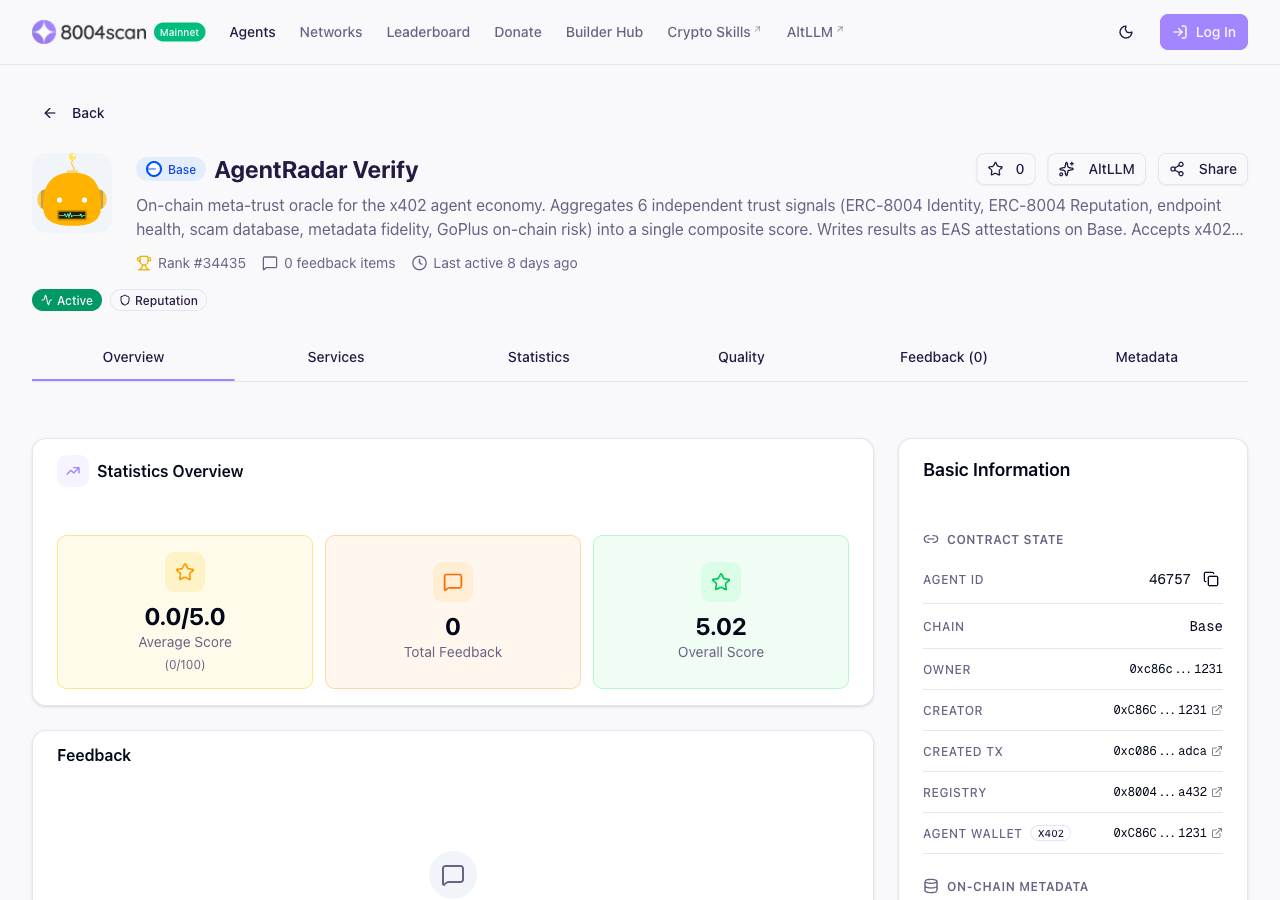
Three months from empty repo to production: an API on Cloudflare's edge runtime, a $12/month VPS listening to blockchain events, a public console, an 18-tool MCP server so any Claude or GPT agent can call the service natively, and the agent itself registered on-chain — Agent #46757 on Base mainnet, with 29 signed attestations written to the Ethereum Attestation Service. Total gas spent for a permanent on-chain presence: about four cents. This is the part of the penny economy that still amazes me: the entire on-chain footprint of a functioning trust oracle costs less than a postage stamp.
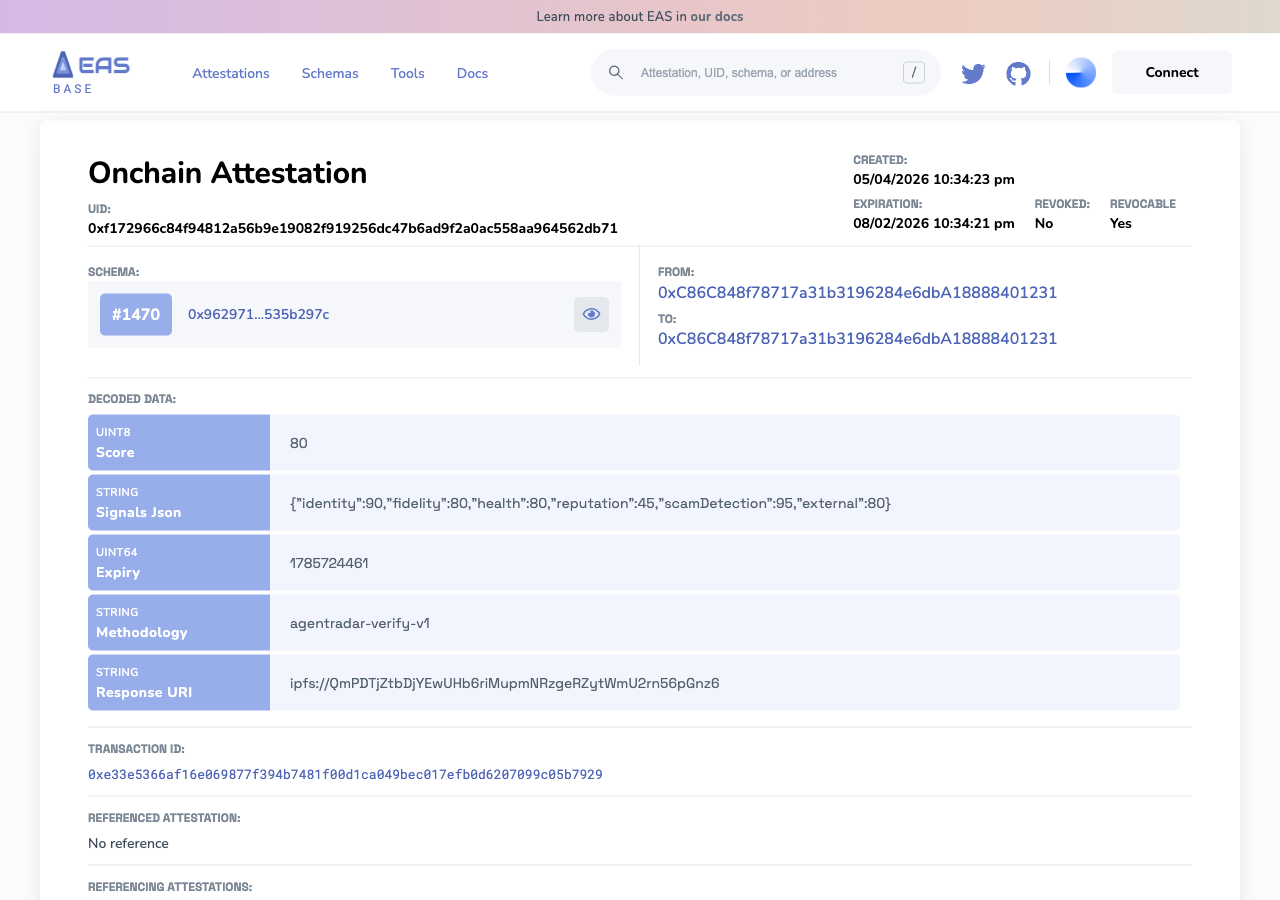
Traces a paid verification: 402 challenge → payment settle → registry reads + scam-DB check + live probes → weighted score → EAS attestation → response. Real production hops, annotated with measured cost and latency.
The Score
The scoring pipeline weighs six independent signals into a 0–100 verdict. The weights are opinionated and public. Try the presets — the third one is a real production result from the day an OFAC-sanctioned Tornado Cash router address was submitted:
The Books
| Line item | Amount | Note |
|---|---|---|
| Monthly infrastructure | ~$12 | one VPS; everything else free tier |
| Total mainnet gas, all time | ~$0.04 | 29 EAS attestations + registrations on Base |
| Production queries served | 61 | mostly demos and my own agents |
| Paid x402 calls received | 0 | as of mid-June 2026 |
| Revenue, all time | $0.00 | — |
| Upstream merges | 3 | ElizaOS registry, awesome-x402, x402 lifecycle-hooks adoption |
Zero revenue. Zero paying customers. I want to be precise about what that number means, because it's the single most informative data point in this article. The service works — it correctly scored the Tornado Cash router at 5 and blocked it; the attestations are on-chain and verifiable; the code was merged into the ecosystem's official tooling. The thesis that failed was distribution: "agents will discover and pay us." I spent three weeks getting listed on every significant MCP directory — the app stores of the agent world — and measured the resulting organic traffic. Approximately zero. Autonomous agents do not browse directories and evaluate vendors. Not yet. There are hundreds of thousands of registered agents and, as far as I can measure, almost no agent demand — the registered population is mostly claims, not miners.
The comedy beat, since a full ledger includes those: for several weeks, my trust oracle's own profile on 8004scan scored "Unhealthy — quality 5/100," because the metadata I'd registered declared service endpoints I hadn't shipped yet, and the explorer's health probe dutifully found them missing. A trust scorer flagged by the trust-scoring infrastructure. I fixed it in June; the health score healed to 100. I keep the screenshot as a reminder that in this economy the auditors get audited, which is — genuinely — the system working.
And the pivot the numbers forced: stop building a destination and start embedding where attention already is. The score now ships as a pre-payment hook inside the x402 client lifecycle — check trust in the beat before the payment fires, at the one chokepoint every transaction crosses — and as integration packages inside agent frameworks, rather than as a website anyone must choose to visit. Whether that works is the next three months' ledger.
Receipts — primary sources, verifiable by anyone
- Agent #46757 on Base: 8004scan profile · rnwy explorer
- First mainnet attestation: EAS UID 0xf172966c…db71
- Live service: api.vvpro.ai · @agentradar/mcp on npm
- Merged upstream: elizaOS/eliza #8466 · awesome-x402 #537
- Market data: x402scan · 8004scan · agenteconomy.to
- The $0.066 shopping spree: every purchase on-chain from 0x3cb6…e420 (July 10, 2026, ~00:37 UTC)
Shovels Worth Selling
If the pattern of 1849 holds — and three months inside suggests it's holding with uncanny fidelity — then the builders who do well in the next phase won't be the ones digging for agent demand. They'll be the ones equipping everyone else. Here's where the gaps are, ranked by how loudly the data asks for them:
Spend firewalls for agent wallets
The $4.5M honeypot exposure exists because nothing stands between an agent's wallet and a malicious price. Per-agent budgets, payee allowlists, anomaly blocking — the "credit card fraud department" of the machine economy. No standard exists. Someone will own this.
Accounting for machine money
An agent making hundreds of sub-cent purchases across services and chains generates a bookkeeping problem no tool addresses: receipts, spend dashboards, tax export. QuickBooks was built for exactly this moment in a previous economy.
Threat feeds at the payment layer
Scam-wallet blocklists and honeypot feeds, consumed by routers and wallets at pay-time. The data exists in fragments (my own scam DB holds 272 wallets from six sources); the subscription product doesn't.
A facilitator seat, while they last
Twenty-nine operators currently collect the only toll that wins in every scenario. Early facilitators become defaults, control leaderboard attribution, and sit where the float accumulates. This window closes as the set saturates.
Standards, before they freeze
Receipt formats, trust headers, session conventions are still unstandardized. Shipping the library that becomes the default is the cheapest durable position in any protocol economy — and the x402 spec is still moving.
Honest ranking help
Most legitimate builders rank poorly for fixable reasons — incomplete agent cards, dead declared endpoints, stale metadata (ask me how I know). The "SEO consultant" of the agent economy is an obvious, unclaimed, white-hat business.
One more number, because it captures the moment better than any other pair I found. In the four weeks before publication, downloads of @x402/core — the protocol's developer SDK — nearly doubled, up 88% month-over-month to ~723K. Over the same stretch, on-chain dollar volume fell to a small fraction of its winter peak. Builders are arriving faster than customers, by an enormous margin. In a normal market that's a warning. In a gold rush, it's the demographics of 1849: the ships keep landing regardless of this month's yield, because everyone aboard is betting on the vein, not the tailings.
The Meta-Lesson
The infrastructure narrative matured faster than the demand. That's the whole finding, and it isn't a criticism — it's a timing signal. The rails are real, the institutional money is real, the protocols work, and the customers are still mostly hypothetical. Every gold rush has a period where the shovel-sellers get paid and the miners work on faith. The on-chain data says we're in it. The record also says such periods end, usually faster than the people inside them expect — and that when this one does, the trust problem I spent three months on stops being a $0-revenue thesis and becomes the constraint on the entire economy. I'd rather be early with receipts than punctual without them.
Sources & Data
- 2026 — 30-day transaction and volume data, service leaderboard; June 15 and July 9 snapshots
- 2026 — ERC-8004 agent counts, leaderboard mechanics, health scoring; homepage vs. API counter comparison
- 2026 — cross-protocol aggregates: ~150M tx, ~$40.7M, 18 facilitators, 7 chains
- 2026 — daily organic x402 volume estimates ($38–64K/day, June)
- 2026 — x402 first-year: 169M payments, ~590K buyers, ~100K sellers (June 7)
- 2026 — x402 Foundation launch, 22 founding members (April 2)
- 2026 — De Rossi (MetaMask), Crapis (Ethereum Foundation), Ellis (Google), Reppel (Coinbase) — Trustless Agents standard, draft
- 2026 — x402 Bazaar audit: 87% of ~19.5K listings spam; 57% of 405 probed services non-functional; ~10,658 template listings from one wallet (February)
- 2026 — "We probed 20,338 x402 endpoints. 161 are agent honeypots." — $4.52M aggregate honeypot pricing; one provider holding 52% of the catalog
- 2026 — ClawHavoc: 341 of 2,632 ClawHub skills malicious at first audit (~13%); campaign total later counted at 1,184 poisoned skills
- 2026 — UNK_DeadDrop / x402-kit phishing campaign attribution (April–May)
- 2026 — 7.1% of ClawHub skills leak API keys via LLM context
- 2026 — AgentRadar attestations and gas costs, on-chain, independently verifiable
- 2025 — x402 protocol announcement and specification
- 1997 — HTTP/1.1: status code 402 "reserved for future use"
- 2026 — author's own Mongo ledger: 61 queries, 29 attestations, $0 revenue. The most audited numbers in this article.
- 2026 — 19 paid x402 calls from a throwaway wallet, July 10: 15 returned real data (79%), $0.066 total. Raw evidence JSON with settle proofs retained.